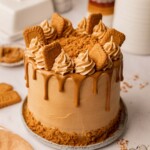
Vegan Biscoff Cake
Indulgent vegan Biscoff cake made with layers of fluffy Biscoff sponge cakes, and a rich Biscoff buttercream! This epic dessert has lots of Biscoff flavor (we're using more than 1 jar) and is perfect for any time of the year.
Ingredients
Wet ingredients
- 1 ¾ cups (440g) dairy-free milk
- 1 ½ cups (300g) granulated sugar
- ⅔ cup (165g) neutral flavored oil
- ½ cup (120g) Biscoff spread slightly melted, but not too hot
- 1 tablespoon apple cider vinegar white vinegar or lemon juice
- 1 tablespoon vanilla extract
Dry ingredients
- 3 cups (375g) all-purpose plain flour spoon and leveled (note 1)
- 3 teaspoons baking powder
- ¼ teaspoon baking soda
- 1 teaspoon ground cinnamon
- Pinch of salt
To decorate
- 1 cup (240g) Biscoff spread room temperature (optional: plus 3/4 cup or 180g for the filling and cake drip)
- 1 cup (220g) vegan butter room temperature
- 3 - 4 cups (300-400g) powdered sugar / icing sugar or to taste
- 1 teaspoon vanilla extract
- ~10 Biscoff cookies whole or crumbled
Instructions
Make the Biscoff cake:
- Preheat your oven to 180°C (350°F). Grease or line 3 x 6-inch (15 cm) round cake pans with parchment paper. You can also use 2 x 8-inch (20 cm) cake pans.
- Add all the wet ingredients to a large mixing bowl and mix until well combined. Try to make sure the Biscoff is fully dissolved. Add all the dry ingredients and mix until just combined. The batter should be quite runny.
- Evenly divide the cake batter into your 3 prepared pans. Bake for 35-40 minutes or you can insert a toothpick in the center of each cake and it comes out clean. If you use larger cake pans, your baking time will be a little shorter. Allow the cakes to cool in the tins for 20 minutes then place them on a wire rack.
- When the cakes cool, store them in an airtight container to prevent the top and sides from drying out.
Make the Biscoff frosting:
- Add the 1 cup (240g) of Biscoff spread and vegan butter to a large bowl (if using a hand mixer) or a stand mixer with the whisk or paddle attachment. Beat on high speed for 3-5 minutes until the mixture is light and fluffy.
- Add the powdered sugar and vanilla to the bowl. Beat on low speed for 30 seconds or until the sugar is fully incorporated. Increase to high and beat the frosting for another 5 minutes or until it's light and fluffy.
- Taste test the frosting. For a sweeter or firmer frosting, add more sugar. For a softer frosting, add 1-2 tablespoons of dairy-free milk, then beat the frosting again.
Assemble and decorate the cake:
- If the cakes have domes, use a serrated knife to trim them off (note 2).
- Place one cake layer on a serving plate and spread around 1/3 cup of Biscoff frosting on top. If you'd like Biscoff filling between your layers, use a piping bag with a large round nozzle to pipe a 'dam' of frosting (see Image 8 in the blog post). Melt around 1/4 cup (60g) of biscoff spread until it's runny and lukewarm, but not hot. Pour the spread in the middle of the 'dam'.
- Place another cake layer on the frosting making sure it is level. Repeat until you've used all 3 cake layers.
- Spread the remaining Biscoff buttercream on the tops and sides of the cake, as desired. If your cake is crumbly, you can crumb coat your cake if desired (I didn't need to). Chill the cake in the fridge or freezer for 10 minutes.
- Using a piping bag, pipe the remaining melted Biscoff spread on the sides of the cake to make a drip. Top with any remaining buttercream, whole and crushed Biscoff cookies. The cookies will soften after a few hours when placed on the cake, so if you're serving this cake later, place the Biscoff cookies on the cake just before serving.
- Store any leftovers in an airtight container at room temperature for 2-3 days, in the fridge for up 4-5 days or in the freezer for up to 1 month. Allow the cake to come to room temperature before eating.
Notes
- If your flour has lumps in it, sift it before adding to the wet ingredients.
Also, make sure you measure your flour accurately, otherwise your cake will be dry and dense. For the best results, use the gram measurements. If using measuring cups, spoon and level your flour by fluffing up the flour in its container, use a spoon to add flour to your measuring cup, and level it off with a knife. Using your measuring cup to scoop flour out of the container will pack too much flour into your cup and batter. - Depending on your oven and ingredients, sometimes the top of the cakes can be a little crispy, whereas the inside is very soft and spongey. If your knife can't 'grip' onto the cake, brush the top of the cakes with water, and cover them with an airtight container or plastic wrap. This will soften the tops of the cakes. Alternatively, just trim the cake a little further down.